
Supply Chain Management
Basic Approach
Zeon Group believes that in order to fulfill social responsibilities such as environmental and human rights considerations across the entire supply chain, it is essential not only for our Group but also for our business partners to align our direction and advance initiatives together. As guidelines for our initiatives, we have established the Zeon Group Sustainable Procurement Guidelines, and we share the guidelines with our business partners and ask for their understanding of the objectives.
Going forward, we will continue to review the guidelines as appropriate in light of social demands for a sustainable supply chain, and, through collaboration with our business partners, fulfill our social responsibilities including environmental and human rights considerations.
Structure and System
We aim for a robust and sustainable supply chain by considering each of the environmental, social, and governance (ESG) aspects. As a system to advance this effort, we have established the Sustainability Conference and the Sustainability Committee under it, each of which meets regularly twice a year. These bodies also deliberate and decide as necessary on initiatives related to respect for human rights and the environment while also factoring in the supply chain, steadily advancing our measures. We have also established a supply chain reporting hub as a point of contact for any legal or compliance violations or human rights abuses within the supply chain.
Key Initiatives
Sustainable procurement initiatives
To promote sustainable procurement, Zeon works with its business partners to implement measures that embody concern for CSR (including human rights and environmental protection) throughout the supply chain. We take the steps outlined in the diagram below.

1. Sharing of our Sustainable Procurement Guidelines
In FY2023, we established our Sustainable Procurement Guidelines, which set out our Group’s fundamental approach to procurement and our commitment to building a sustainable supply chain. The Guidelines were distributed to suppliers in FY2024, and we are aiming to ensure that Zeon’s approach to sustainability and our strategy for related initiatives are disseminated throughout the supply chain.
In addition, to promote understanding and internalization of the Guidelines within the Company, we continue to conduct training sessions and briefings for procurement personnel to enhance their understanding and share key points for practical implementation.
Zeon Group conducts responsible procurement activities based on our " Sustainability Policy" aiming to realize a sustainable society throughout the supply chain.
- 1Compliance with laws and social norms
We comply with laws and social norms and conduct fair procurement activities based on corporate ethics.
- 2Optimal procurement of raw materials, products, and services
We strive to ensure the optimal procurement of raw materials, products, and services in respect of safety, quality, price, delivery date, supply stability, and technical capabilities to provide better products.
- 3Consideration for the global environment
We strive to procure raw materials and products that have less negative impact on the global environment, giving consideration to conservation of environment, resources and biodiversity.
- 4Consideration for human rights
We respect human rights in our supply chain and strive to procure raw materials, products, and services that are human rights friendly.
- 5Promoting responsible mineral sourcing
We strive to responsibly procure minerals to avoid involvement in conflicts, environmental destruction, and human rights violations in conflict-affected and high-risk areas.
- 6Appropriate management of information
We understand the importance of confidential information obtained through procurement activities, and striving to use, manage, and protect it appropriately.
- 7Open purchasing attitude and partnership
We look for business partners from a global perspective, striving to ensure fair, impartial, and transparent business opportunities, and build partnerships with our suppliers through dialogue to realize mutual development and a sustainable society.
Sustainable Procurement Guidelines
2. Supplier surveys
To monitor the implementation status of suppliers’ sustainability initiatives and identify risks, we implement surveys targeting existing suppliers on a regular basis.
For the survey, we use the “Zeon Corporation CSR Procurement Self-Assessment Questionnaire” (SAQ), which was developed by the Company based on the common self-assessment questionnaire (SAQ) provided by the Global Compact Network Japan (GCNJ).
The purchasing departments for raw materials, materials, and logistics select those suppliers that account for over 80% of procurement value and suppliers that are felt to have a high risk of human rights related issues, etc.
In FY2024, SAQs were delivered by the relevant departments to a total of 140 suppliers, of which 134 suppliers (96%) returned a completed SAQ. With regard to the six non-responding suppliers, we checked the sustainability-related information on each company’s website, and confirmed that no major risks were apparent at the present time.
- ⅠCSR-related corporate governance
Establishment of a CSR promotion system, Establishment of internal controls, Establishment of a business continuity planning (BCP) system, Establishment of a whistle-blower system, and Dispatch of CSR-related information inside and outside the company
- ⅡHuman Rights
Basic attitude toward human rights, Respect for human rights and prohibition of discrimination, Avoidance of complicity in (or contribution to) human rights abuses, Respect and consideration for the life and culture of the local community and indigenous people, and Requests for suppliers to comply with applicable requirements
- ⅢLabor
Basic attitude toward labor practices, Prohibition of discrimination in the workplace, Provision of equal opportunities to employees regarding human resources development and career advancement, etc., Prohibition of inhumane treatment, Payment of fair wages, Fair application of working hours, time off, and paid time off, etc., Prohibition of forced labor, Prohibition of child labor, Respect for the religious traditions and customs of the country of operation, Recognition of and respect for freedom of association and the right to collective bargaining, and Proper management of employee safety and health
- ⅣEnvironment
Basic attitude toward environmental initiatives, Control and reduction of wastewater, sludge and air emissions, Control and reduction of wastewater, sludge and air emissions, Sustainable and efficient utilization of resources (energy, water, raw materials, etc.), Reduction of GHG (greenhouse gases), Identification management, reduction, and responsible disposal or recycling of waste, and Initiatives related to biodiversity
- ⅤFair Business Practices
Basic attitude toward fair business practices, Establishment of appropriate relationships with local governments and public officials in and outside countries where business activities are conducted, Prevention of the giving and receiving of improper advantages with customers and trade partners, etc., in sales and purchasing activities, etc., Prevention of competition law violations in sales activities, etc., Rejection of relationships with antisocial forces/organizations, Prevention of unauthorized use of a third party’s intellectual property and of illegal reproduction of copyrighted works, Services for responding to complaints from outside the company and for consultations, Prohibition of insider trading, Prohibition of acts with conflicting interests
- ⅥQuality and Safety
Basic attitude toward product and service quality and safety, Ensuring product and service quality and safety, Appropriate response to product and service accidents and the circulation of defective goods
- ⅦInformation Security
Basic attitude toward information security, Defense against attacks on computer networks, Protection of personal information and privacy, Prevention of misuse of confidential information
- ⅧSupply Chain
Basic attitude toward the supply chain, Use of raw materials not involved in conflict or crime (initiatives against conflict minerals)
- ⅨHarmonious coexistence with local communities
Initiatives to reduce damage to the health, safety, and sanitation of local communities and residents, Initiatives with contribute to the local community and residents and collaborate towards sustainable development
3. Identifying and analyzing risks based on survey results
Based on the above survey results, we analyzed the risks with each supplier and clearly identified points requiring improvements.
4. Feedback
We provide a feedback sheet based on the analysis resultsreferred to in 3. above to all suppliers that completed the common SAQ. The feedback sheet includes the score for each assessment item, including human rights, labor affairs, environmental protection, as well as the overall average score, a comparison with the previous survey, and an overall evaluation.
Suppliers can objectively understand their own progress, enabling them to continuously improve their CSR activities.
In addition, we conduct on-site assessments and hold feedback interviews for those suppliers that have a relatively low score on the common SAQ and may present higher CSR risks, and those suppliers handling raw materials that are deemed to be particularly high-risk from a CSR perspective. In the interviews, besides explaining the importance of sustainable procurement, we also confirm the status of initiatives based on the common SAQ, and request improvements where necessary. The average score for the five companies subject to on-site assessments and feedback interviews in FY2022 was 283 points (out of 900 points), but in FY2024, it had risen substantially to 488 points.
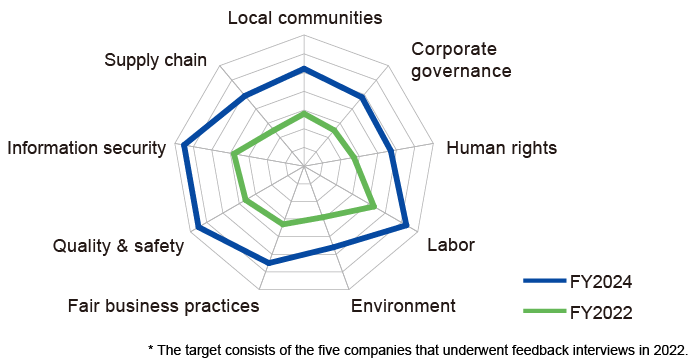
In FY2024, we also conducted feedback interviews with 11 companies. Through the dialogues outlined in the table below, we are advancing initiatives toward continuous improvement.
| CSR-related issues | Dialogue for improving CSR activities, and content of advice to suppliers |
|---|---|
| Enhancement of transparency |
|
| Formulation of a human rights policy | Introduction of the UN Global Compact and the formulation guidelines issued by the Ministry of Economy, Trade and Industry |
| Conflict minerals | Review of risk management status and sharing of issues related to conflict minerals |
Monitoring of suppliers
While conducting the due diligence described above, we will monitor overall changes in the common SAQ percentage score and the improvement status of companies with low percentage scores, and, as necessary, conduct on-site assessments and engage in dialogue for improvement through additional interviews. Through support that leads to improvements by our suppliers and other efforts, we will advance sustainability risk mitigation initiatives and work to strengthen our sustainable supply chain.
| 指標 | FY2022 | FY2024 |
|---|---|---|
| SAQ Collection Rate | 77% | 96% |
| Number of Suppliers Supported Through On-Site Audits and Feedback Meetings | 16 (6.1%) |
11 (7.8%) |
Collaboration with outside parties
We participate in the GCNJ’s supply chain subcommittee every year and gain diverse insights through it. We also actively engage in the preparation and publication of the subcommittee’s deliverables, incorporating them into our initiatives.