
Natural Capital and Biodiversity Conservation
Basic Approach
Under its corporate philosophy of "Contributing to the preservation of the Earth and the prosperity of the human race," the Zeon Group aspires to realize a "Sustainable Earth" and a "Safe and Comfortable Life" through innovative technologies, products, and services. Zeon promotes value creation by linking the Five Gears set out in our materiality, believing that these initiatives lead to the "coexistence of nature and humankind," which includes the conservation of biodiversity. As a company that supports society through the integrated utilization of C4 and C5 materials derived from crude oil, we recognize that while we benefit significantly from natural capital, our business activities may also have direct and indirect impacts on biodiversity. Internationally, the Kunming-Montreal Global Biodiversity Framework, which sets out to halt and reverse biodiversity loss by 2030, has been adopted, and the conservation of natural capital has become an essential consideration for sustainable corporate growth. In light of this trend, we position our relationship with nature as an important theme and work to identify and reduce our dependencies and impacts across the value chain. Based on this recognition, we support the principles of the Task Force on Nature-related Financial Disclosures (TNFD) and promote disclosure based on its framework. By appropriately identifying our dependencies and impacts on natural capital, together with the risks and opportunities arising from them, and through transparent disclosure and its integration into management, we aim to achieve both sustainable growth and enhanced corporate value.
Disclosure Based on the TNFD Recommendations
Evaluation Process for Risks and Opportunities Related to Natural Capital
The Zeon Group seeks to understand how its dependencies and impacts on natural capital affect its business model, thereby helping to maintain and enhance corporate value over the medium to long term. To this end, we identified nature-related issues and examined appropriate responses based on the recommendations of the Taskforce on Nature-related Financial Disclosures (TNFD) *1 and the TNFD-recommended LEAP approach *2. The LEAP approach is a methodology for identifying and assessing nature-related issues through the following four phases. To make the assessment efficient and effective, we narrowed the scope of business activities and geographic areas across our value chain during the Scoping phase, while flexibly redefining the scope as the analysis progressed and new insights emerged.
- *1Taskforce on Nature-related Financial Disclosures (TNFD) Recommendations
- *2Guidance on the identification and assessment of nature-related issues: the LEAP approach
- Locate (Identifying interfaces with nature)
Identify potential nature-related issues associated with our business activities, including the supply chain, determine where these interfaces with nature occur, and prioritize them.
- Evaluate (Assessment of Dependencies and Impacts)
Quantitatively and qualitatively evaluate the benefits our business receives from nature (dependencies) and the impacts of our activities on ecosystems at the identified interfaces with nature.
- Assess (Assessment of Risks and Opportunities)
Based on the assessment of dependencies and impacts, identify physical and transition risks to our business, as well as new nature-related business opportunities.
- Prepare (Preparing Responses and Reporting)
Reflect the assessment results in management strategy and resource allocation and prepare for disclosure to stakeholders.
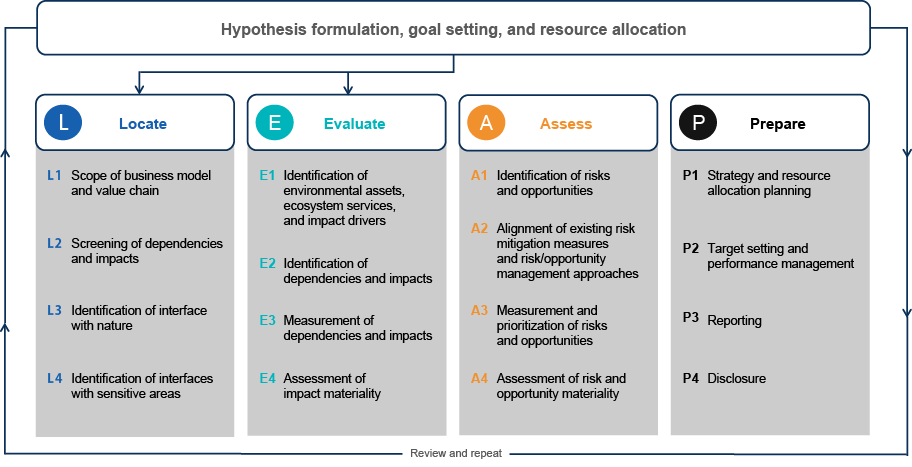
During the current fiscal year, we conducted a trial of the entire LEAP approach. The material issues identified at this stage are disclosed below as the basis for our strategy. Going forward, we plan to integrate the results of this analysis progressively into our governance and risk management systems.
Locate (Identifying Interfaces with Nature)
Screening of Dependencies and Impacts
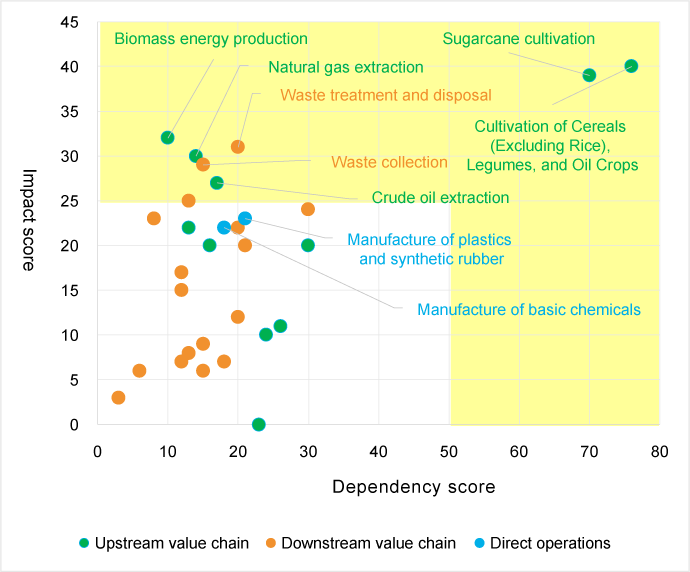
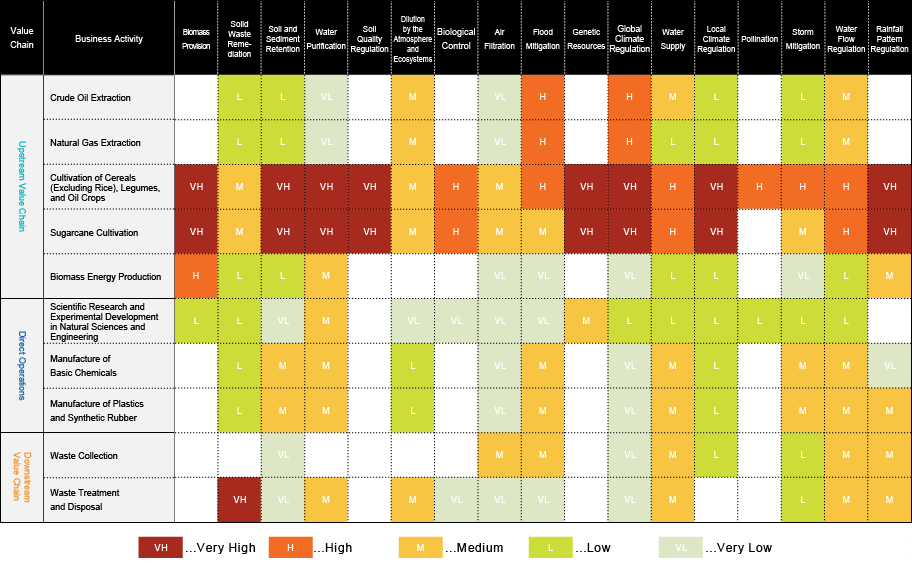
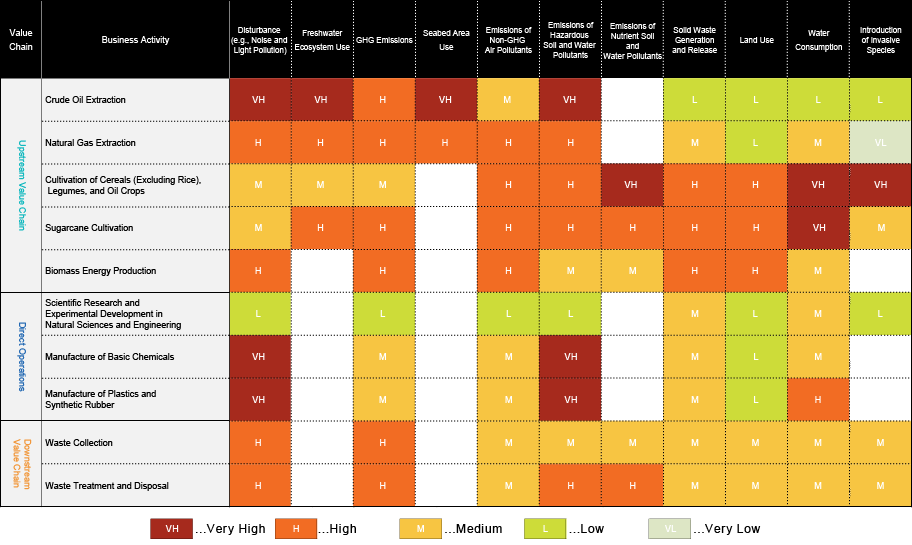
We assessed our dependencies on and impacts on natural capital across the entire value chain (upstream, direct operations, and downstream) for all business segments. We used the international assessment tool ENCORE *3 to score business activities at each process stage in terms of both their dependencies on and impacts on nature. Based on this analysis, we identified sectors with dependencies and impacts above a defined threshold, together with our direct operations, as priority assessment areas and developed a heat map to visualize their relative significance.
- *3ENCORE (Exploring Natural Capital Opportunities, Risks and Exposure):
A tool developed by UNEP-WCMC and other organizations to assess dependencies and impacts on natural capital. It identifies both the ecosystem services on which each business sector depends (dependencies) and the pressures that business activities place on nature (impacts).
- Upstream:
For upstream activities, high dependencies were identified for biomass supply, soil and sediment retention, water purification, and soil quality regulation associated with the cultivation of cereals (excluding rice), legumes, oil crops, and sugarcane. High dependencies were also identified for genetic resources, global and local climate regulation, and rainfall-pattern regulation. The principal impacts included ecosystem disturbance; the use and modification of freshwater and marine ecosystems; and the release of hazardous pollutants into soil and water associated with crude oil extraction. Other significant impacts included the release of nutrient pollutants into soil and water associated with the cultivation of cereals (excluding rice), legumes, and oil crops; water consumption, including in sugarcane cultivation; and the introduction of invasive species. However, because biomass accounts for only a small proportion of the Zeon Group’s total raw material procurement, the Group considers its dependencies and impacts associated with biomass sourcing to be limited.
- Direct Operations:
For direct operations, the principal impacts on nature were identified as ecosystem disturbance, the release of hazardous soil and water pollutants, and water consumption associated with manufacturing processes.
- Downstream:
For downstream activities, waste treatment and disposal were identified as having a high dependency on solid waste remediation services.
From an impact perspective, the principal pressures on nature were ecosystem disturbance, GHG emissions, and the release of hazardous and nutrient pollutants associated with waste collection, treatment, and disposal. The analysis identified the following value-chain activities as having moderate to high dependencies on and/or impacts on nature: sugarcane production, cereal production, natural gas extraction, and crude oil extraction upstream; and waste collection, treatment, and disposal downstream. Sugarcane and cereal production account for only a small proportion of the Group’s total raw material procurement. In addition, the most reliable data were available for direct operations. We therefore identified direct operations as the most appropriate priority area for the initial assessment year and limited the scope of the analysis to our direct operational sites.
Identification of Priority Locations
To better understand nature-related risks and opportunities, we assessed the environmental characteristics of the regions in which our business sites are located and identified priority locations requiring focused attention. In this phase, the assessment covered all manufacturing and R&D sites within the scope of the Zeon Group's direct operations, comprising 31 sites in total (19 in Japan and 12 overseas). Based on the geographic location of each site, the relevant biome was identified, and each site was assessed against the TNFD criteria for ecologically sensitive locations.
- Criteria for Ecologically Sensitive Locations
-
- 1Areas important for biodiversity: Proximity to protected areas or habitats of threatened species
- 2Areas with high ecosystem integrity: Areas where natural ecosystems remain largely intact
- 3Areas with low ecosystem integrity: Areas where ecosystem degradation or loss has progressed
- 4Areas exposed to high physical water risk: Areas facing risks such as water scarcity or water pollution
- 5Areas important for the provision of ecosystem services: Areas where ecosystem services on which our business depends are also essential to local communities
The analysis used globally recognized external databases, including the WWF Biodiversity Risk Filter *4, to score each site’s environmental characteristics quantitatively and objectively.
- *4WWF Biodiversity Risk Filter: A tool developed by the World Wide Fund for Nature (WWF) to assess biodiversity-related risks at business sites and across supply chains. Based on site location data, it visualizes physical, regulatory, and reputational risks.
As a result of the analysis, 18 of the 31 sites assessed (13 in Japan and five overseas) were identified as priority locations with the potential to have significant nature-related issues, based on the criteria described below.
| VC | Criteria for selection | Number of sites | Total |
|---|---|---|---|
| All 31 sites in direct operations | Sites with high physical water risk (e.g., pollution, water stress, water depletion) | 12 | 18(58%) |
| Sites important for biodiversity (located near Key Biodiversity Areas (KBAs)) | 4 | ||
| Sites with high physical water risk and also important for biodiversity (located near KBAs) | 2 | ||
| Not applicable | 13 | - |
- *KBA (Key Biodiversity Area): A site that contributes significantly to the global persistence of biodiversity across terrestrial, freshwater, and marine ecosystems.
- **Sites located within approximately 5 km (straight-line distance) of a KBA were regarded as being in close proximity.
Evaluate (Assessment of Dependencies and Impacts)
For the 18 priority locations identified in the Locate phase, we assessed business-process inputs and outputs, as well as environmental management items. Based on these operational data, we then evaluated our dependencies on and impacts on nature in detail.
Dependencies on Nature
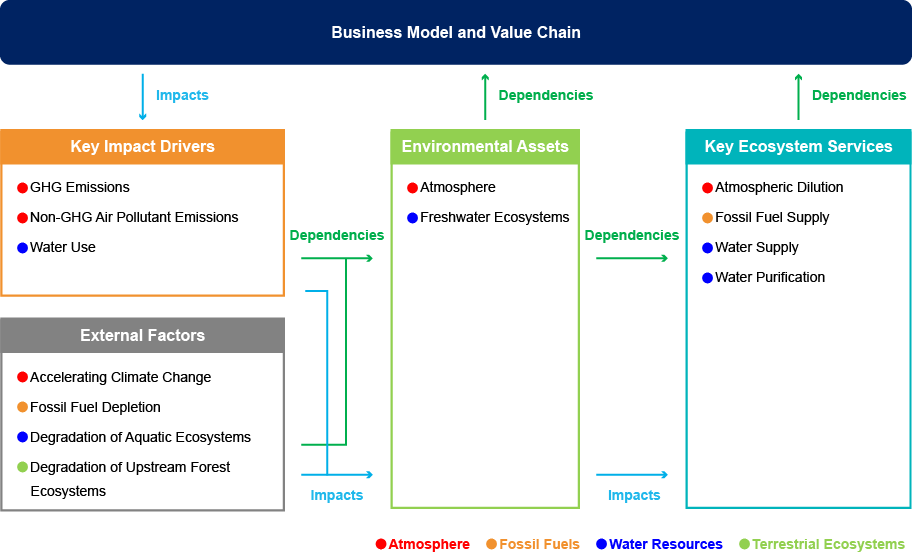
The manufacture of our chemical products depends on a wide range of ecosystem services, the stability of which forms an essential foundation for the stable supply of our products. Our principal dependencies with relatively high significance are as follows:
- High dependence on petrochemical feedstocks:
Our operations rely heavily on fossil-based materials, particularly C4 and C5 feedstocks.
- Dependence on water quality regulation, water supply, and the natural purification capacity of water:
Our operations in Japan require substantial volumes of water, and we depend on water flow regulation services to ensure a stable water supply. In addition, although wastewater is treated under strict discharge standards using our own wastewater treatment facilities, the treated effluent ultimately depends on ecosystem services such as the natural purification, dilution, and dispersion capacity of receiving waters.
- Atmospheric dilution:
Although we have implemented the measures available to us, emissions from smoke-generating facilities and releases of chemical substances to the atmosphere remain, and we therefore continue to rely on the atmosphere’s natural dilution capacity.
Impacts on Nature
Our business activities involve certain environmental impacts arising from our manufacturing processes, which have both direct and indirect effects on climate change and local ecosystems. Our principal impacts on nature with relatively high significance are as follows:
- Water consumption and the discharge of water pollutants:
In addition to contributing to regional water stress through substantial water withdrawals, our operations discharge significant volumes of wastewater into public water bodies. Furthermore, at sites located in areas with a high risk of eutrophication, we discharge substantial volumes of wastewater containing organic matter.
External Factors That May Affect the Availability of Ecosystem Services
In addition to our direct impact on nature, we identified the following external factors as potential threats to the availability of the ecosystem services on which our business depends.
- Depletion of fossil resources:
Because most of our raw materials are derived from fossil resources, their future depletion could affect our business operations.
- Changes in water supply conditions:
Pollutant discharges, excessive water withdrawals, and ecosystem degradation caused by third parties could impair water purification functions and reduce water flow regulation services, potentially affecting our business operations.
- Decline in the atmosphere's natural dilution capacity:
Large-scale emissions of pollutants by third parties could reduce the atmosphere's natural dilution capacity.
Assess (Assessment of Risks and Opportunities)
In the Assess phase, we conducted a comprehensive assessment of how the dependencies and impacts on natural capital identified through the previous analyses could give rise to nature-related risks and opportunities for our business activities.
Focusing on our direct operations and the related value chain within the priority locations, we identified potential nature-related risks and opportunities. For each item, we qualitatively assessed the likelihood of occurrence and its potential impact on our business strategy and financial performance. Through this process, we identified the most significant risks and opportunities requiring management attention and examined appropriate response measures.
| Risk | Category | Dependencies / Impacts / External Factors | Risk Description | Time Horizon | Likelihood | Financial Impact | Response Measures |
|---|---|---|---|---|---|---|---|
| Physical Risk | Acute | Dependency: Water supply; water regulation (large-scale water intake at domestic sites and water withdrawal risks at overseas sites) | Risk of water withdrawal restrictions and suspension of operations in water-stressed areas due to the deterioration of water regulation functions caused by climate change. | Medium to long term | Medium | High | • Develop business continuity plans (BCPs) that assume water transfer from other sites or external water procurement (currently underway). |
| Chronic | Dependency: Other provisioning services (subsurface resources) (dependence on naphtha and other feedstocks) | Risk of unstable raw material procurement and increased procurement costs resulting from the tightening of global resource extraction regulations aimed at protecting natural capital. | Long term | Medium | Medium | • Promote supply stability and reduce market fluctuation risks through the establishment of a global procurement network for C4 and C5 feedstocks and the conclusion of long-term supply agreements with key customers (currently underway). | |
| Transition Risk | Reputation | Impact: GHG emissions; water consumption (significant GHG emissions and water withdrawal across domestic business sites) | Risk of divestment due to inadequate responses to nature-related issues and loss of trust among local communities. | Medium term | Medium | Medium | • Implement water recycling at manufacturing plants and conduct regular monitoring of water quality and water consumption (currently underway). • Begin disclosure of progress on TNFD (Taskforce on Nature-related Financial Disclosures) initiatives from FY2025 (not yet implemented). |
| Regulations and Policies | Impact: Emissions of non-GHG air pollutants (accounting for more than 30% of Japan's total ethyl acrylate emissions) | Risk of stricter emission regulations for specific chemical substances to prevent pollution, as well as the introduction of taxes and fees based on environmental impact. | Medium to long term | Medium | Medium | • Recognize the reduction of ethyl acrylate emissions as a key issue and are currently conducting technical and economic studies on the introduction of emission control equipment, including flare stacks (Currently underway). | |
| Regulations and Policies | Impact: Emissions of soil and water pollutants (discharge of organic matter into water bodies in areas at risk of eutrophication) | Risk of increased management burden and capital investment costs resulting from the introduction of stricter wastewater discharge standards aimed at protecting ecosystems. | Medium to long term | Medium | Medium | • Maintain wastewater treatment systems in compliance with the Seto Inland Sea Environmental Conservation Act and relevant prefectural pollution control ordinances (Currently underway). |
| Category | Dependencies / Impacts / External Factors | Opportunity Description | Time Horizon | Likelihood | Financial Impact | Response Measures |
|---|---|---|---|---|---|---|
| Products and Services | High-performance materials and biomass-based materials | Opportunity to expand revenue by rolling out nature-conscious products such as biomass-based and biodegradable materials and water treatment resins. | Medium term | Medium | Medium | • Obtain ISCC PLUS certification for domestic manufacturing plants (Takaoka, Kawasaki, Tokuyama, and Mizushima). (Completed) • Conduct research and development of technologies for producing butadiene and isoprene from biomass-derived feedstocks. (Currently underway) • Introduce ammonia combustion facilities at manufacturing plants and develop, implement, and promote ammonia combustion technologies. (Currently underway) • Develop hydrogen power generation and hydrogenated materials through shared use of facilities with neighboring industrial complexes (not yet implemented). |
| Finance | Integrated TNFD/TCFD disclosures | Opportunity to enhance external evaluations through TNFD and related disclosures and facilitate financing and investment on more favorable terms. | Short to medium term | High | Medium | • Continue disclosures based on the TCFD (Task Force on Climate-related Financial Disclosures) (completed). • Provide disclosures based on the TNFD (Taskforce on Nature-related Financial Disclosures) (currently underway). |
| Resource Efficiency | Recycling and circular technologies (track record of waste recycling in Japan) | Opportunity to improve resource efficiency and reduce procurement risks through the recycling of water and solvents and the application of advanced recycling technologies. | Medium to long term | Medium | Medium | • Reduce the use of carbon feedstocks by using recycled Cyclo Olefin Polymer feedstocks (currently underway). |
| Time Horizon | |
| Short term | 0 to less than 3 years |
| Medium term | 3 to less than 10 years |
| Long term | 10 to 30 years or more |
| Likelihood (Applicable if any of the following conditions are met) | |
| High |
|
| Medium |
|
| Low |
|
| Financial Impact | |
| High | More than ¥5 billion |
| Medium | ¥1 billion to ¥5 billion |
| Low | Up to ¥1 billion |
Prepare (Preparing Responses and Reporting)
In the Prepare phase, we developed and prioritized specific response measures for the key dependencies, impacts, risks, and opportunities identified through the Locate, Evaluate, and Assess phases.
To address the identified nature-related risks and impacts, we adopted the AR3T Framework *4. This framework goes beyond reactive measures by providing a systematic approach to implementing actions in the following order of priority.
- *4AR3T Framework (Avoid, Reduce, Restore & Regenerate, Transform):
A framework proposed by the Science Based Targets Network (SBTN) that prioritizes actions to address negative impacts on nature. It consists of four stages—Avoid, Reduce, Restore & Regenerate, and Transform—and is designed to support contributions toward a nature-positive future.
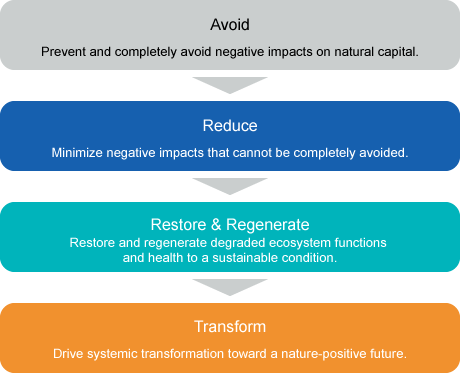
Based on this order of priority, we will promote effective actions to minimize negative impacts on natural capital while maximizing our contribution to a nature-positive future. Specific response measures for each identified risk and opportunity are summarized in Table 2, “Key Risks and Response Measures,” and Table 3, “Key Opportunities and Response Measures.” These include initiatives such as enhancing water recycling systems and conserving local ecosystems.
In addition, we established metrics for the key risks and opportunities with reference to the TNFD-recommended Core Global Disclosure Metrics and Additional Global Disclosure Metrics.
| Metric No. | Category | Metric |
|---|---|---|
| A3.2 | Resource use and replenishment | Total volume of water reduced, reused, and/or recycled |
| C2.1 | Pollution / Pollution removal | Concentration of key pollutants in wastewater discharged |
| A22.0 | Management of dependencies, impacts, risks, and opportunities | Percentage of suppliers assessed (Common SAQ survey: suppliers covered and responses received) |
| C2.4 | Pollution / Pollution removal | Emissions of non-GHG air pollutants |
Future Outlook and Challenges
The identification and assessment of nature-related issues through the LEAP approach has provided the Zeon Group with an important opportunity to reaffirm the value of the natural capital that underpins our business and to reassess its sustainability. The disclosures presented in this report represent only the first step. Going forward, we will further strengthen business resilience by integrating the identified dependencies, impacts, risks, and opportunities more fully into our management strategy and governance framework. We will also promote collaboration across the value chain toward a nature-positive future through ongoing dialogue with a wide range of stakeholders, including local communities.
Key Initiatives
Forest and Marine Ecosystem Conservation Activities in Collaboration with Local Communities
Utilization of Blue Carbon Credits
At the Tokuyama Plant, we participate in activities to maintain the forests that serve as our water source, together with a wide range of stakeholders, including companies that use water resources. These activities are intended to deepen understanding of the role forests play in conserving water resources and mitigating climate change while encouraging voluntary forest maintenance and appropriate management.
We also participate in conservation activities at the Oshima Tidal Flat in Shunan City as part of our efforts to conserve and restore blue carbon ecosystems. In addition, through the Japan Blue Economy Association, we purchase and utilize J Blue Credits® generated by the “Shunan City Blue Carbon Project Connecting from the Oshima Tidal Flat, at the Port of Tokuyama-Kudamatsu”. These credits are used to offset our CO2 emissions while contributing to the conservation of the local natural environment, the promotion of the local fisheries industry, and regional revitalization.
Forest Maintenance and Tree-Planting Activities
Zeon Chemicals Thailand (ZCT), a Group company in Thailand, participated in a tree-planting activity at Samse Hill. By working together to plant trees, employees contributed to expanding green spaces, restoring ecosystems, and creating habitats that support biodiversity conservation. This initiative aims to maintain and enhance natural capital while promoting greater awareness of the sustainable use of natural resources. Through these activities in collaboration with local communities, ZCT also contributes to the realization of a sustainable society in harmony with nature.
Marine Plastic Waste Cleanup
ZCT participated in a beach cleanup at Phayun Beach in Ban Chang District in collaboration with local communities and government agencies. As a petrochemical manufacturer, ZCT recognizes its responsibility for the environmental impacts of its products throughout their life cycles. Through this initiative, the company is addressing marine plastic waste while helping to conserve marine ecosystems. The cleanup helps prevent waste from entering the ocean and supports the maintenance and restoration of natural capital in coastal areas, as well as biodiversity conservation. By working with local communities, ZCT also promotes greater understanding of and responsibility for the company’s dependencies and impacts on natural resources while advancing initiatives to support sustainable resource use and reduce environmental impacts.