
Zeon's Sustainability
Basic Approach
Contributing to the preservation of the Earth and the prosperity of the human race
In keeping with its name, derived from the Greek words “geo” (Earth) and “eon” (eternity), Zeon will contribute to a “Sustainable Earth” and a “Safe and Comfortable Life” by providing original technologies, products, and services.
• We aspire to realize a “Sustainable Earth” and “Safe and Comfortable Life”.
• We will firmly maintain fairness and integrity in our activities to be a trustworthy company.
• Each of us will think and act proactively for a better future.
Based on our corporate philosophy of “Contributing to the preservation of the Earth and the prosperity of the human race,” sustainability at Zeon means achieving sustainable growth together with society. To achieve this, we provide products and services that help solve global and social issues, build trust with our stakeholders by conducting our business with integrity at all times, and each of us works every day with a better future for society and for ourselves in mind.
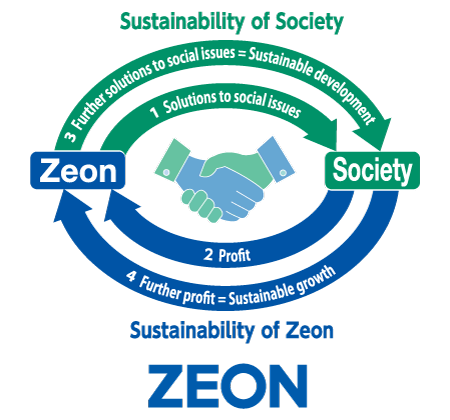
Explanation of the schematic diagram
Zeon uses the schematic diagram below to explain the thinking behind its Sustainability Policy more clearly.
The arrows labeled 1 and 2 inside the diagram represent the flow in which Zeon provides new value to society by helping to solve social issues, and in return, society provides Zeon with compensation for that value, in other words, revenue.
Furthermore, the arrows labeled 3 and 4 show how continuing to realize this virtuous cycle of value can lead to both “sustainable development of society” and “sustainable growth of Zeon.”
The “handshake” depicted in the center of the diagram symbolizes how the relationship of trust between Zeon and society strengthens as this virtuous cycle continues.
Zeon's Materiality
To realize our corporate philosophy of “contributing to the preservation of the Earth and the prosperity of the human race,” and to ensure Zeon’s continued sustainable growth alongside society, we have identified the “Five Gears that drive Zeon,” as the priority issues (materiality).
Five Gears that drive Zeon (materiality)
Creating a truly exciting company

Our most fundamental challenge as a company is to create a workplace where every employee can fully demonstrate their abilities and experience excitement while working; this leads to innovation, the key to our growth. Specific elements include “diversity, inclusion, and belonging (DI&B),” “improvement of job satisfaction and engagement,” and “streamlining and reappraising how we work.”
Providing unique value through innovation
Innovation is the most important keyword for Zeon to grow while meeting societal expectations and we have positioned it as central to the Five Gears. Providing society with value that only our company can create, and that cannot be imitated by others, will lead to the sustainable growth of both society and Zeon. “Creating systems and a culture that foster innovation” and “original technologies, products, and services” are, we believe, the key to keeping all Five Gears turning.
Establishing solid governance
To ensure that “we continue to conduct our business with fairness and integrity and remain a trusted company,” a tenet of the company’s Sustainability Policy, we must strengthen our foundation as a company. This includes not only “management transparency,” “stable and secure production,” “quality,” and “anti-corruption,” but also elements such as “information security,” “sustainable procurement,” and “human rights,” which have come to be recognized as important issues in recent years.
Transforming business structure to respond to social changes
By driving innovation, we will create products and services that meet society’s expectations, and by shifting the focus of our business toward these products and services, we will transform our business structure. From the viewpoint of sustainability, fields such as “digitalization of society,” “advancements in mobility,” and “health and welfare” are areas of high social demand, and by actively bringing innovation mainly in these areas, we will transform our business structure to adapt to social changes.
Contributing to establishing a circular society

A circular society refers to a society in which limited resources are utilized to the maximum extent and environmental impacts are minimized by, for example, promoting recycling and reducing waste. We believe that transforming our business structure by bringing innovation both to our products and services and to how they are produced will contribute to establishing a circular society, and this will in turn help realize our corporate philosophy.
We organized the Five Gears that drive Zeon (materiality) to show the path the company should follow in the future clarifying the relationships among Five Gears. The Five Gears that drive Zeon are the axis that lets us combine our efforts, without wavering, toward realizing our corporate philosophy even in a rapidly changing business environment.
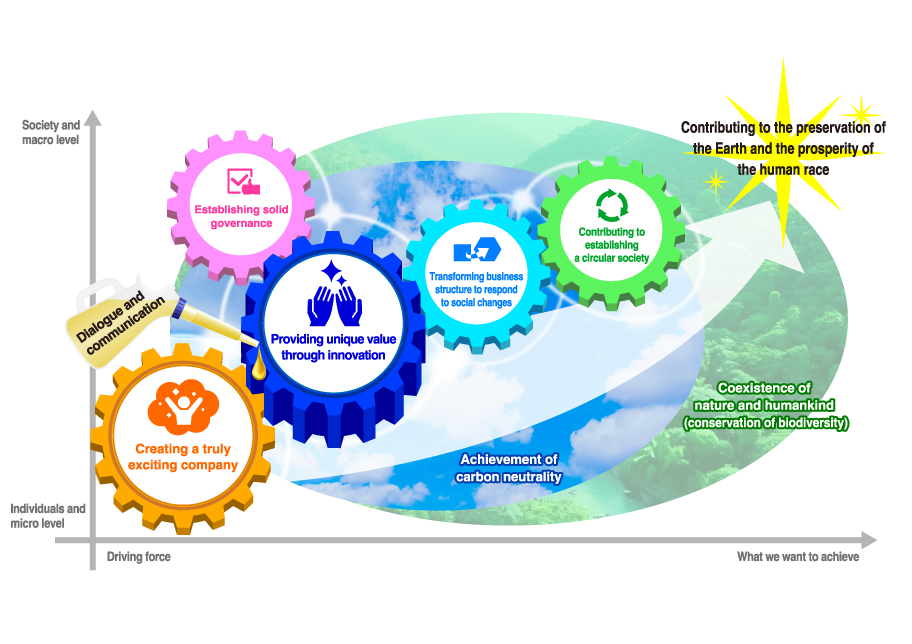
How to Read and Interpret the Diagram
- The vertical axis is structured such that the lower part represents the individual, in other words, the “micro” level, and as we go up, it widens toward society as a whole, in other words, the “macro” level.
- On the horizontal axis, the left-hand side represents the driving force for Zeon Group and the right-hand side what the Group wants to achieve. The diagram indicates that we start from the familiar level as shown in the lower left of the diagram and that as we go to the upper right, our view further widens and we move toward longer-term issues.
- The Five Gears in the diagram interlock with each other , transmitting power from the lower left to the upper right. This represents the driving force that propels the Zeon Group toward realizing its vision, in other words, its corporate philosophy.
- “Dialogue and communication” are essential for keeping each gear rotating smoothly, and this is depicted as a lubricant.
- Keeping the Five Gears rotating leads to solving two major issues for the entire globe behind Zeon’s materiality: achievement of carbon neutrality and coexistence of nature and humankind, including the conservation of biodiversity.
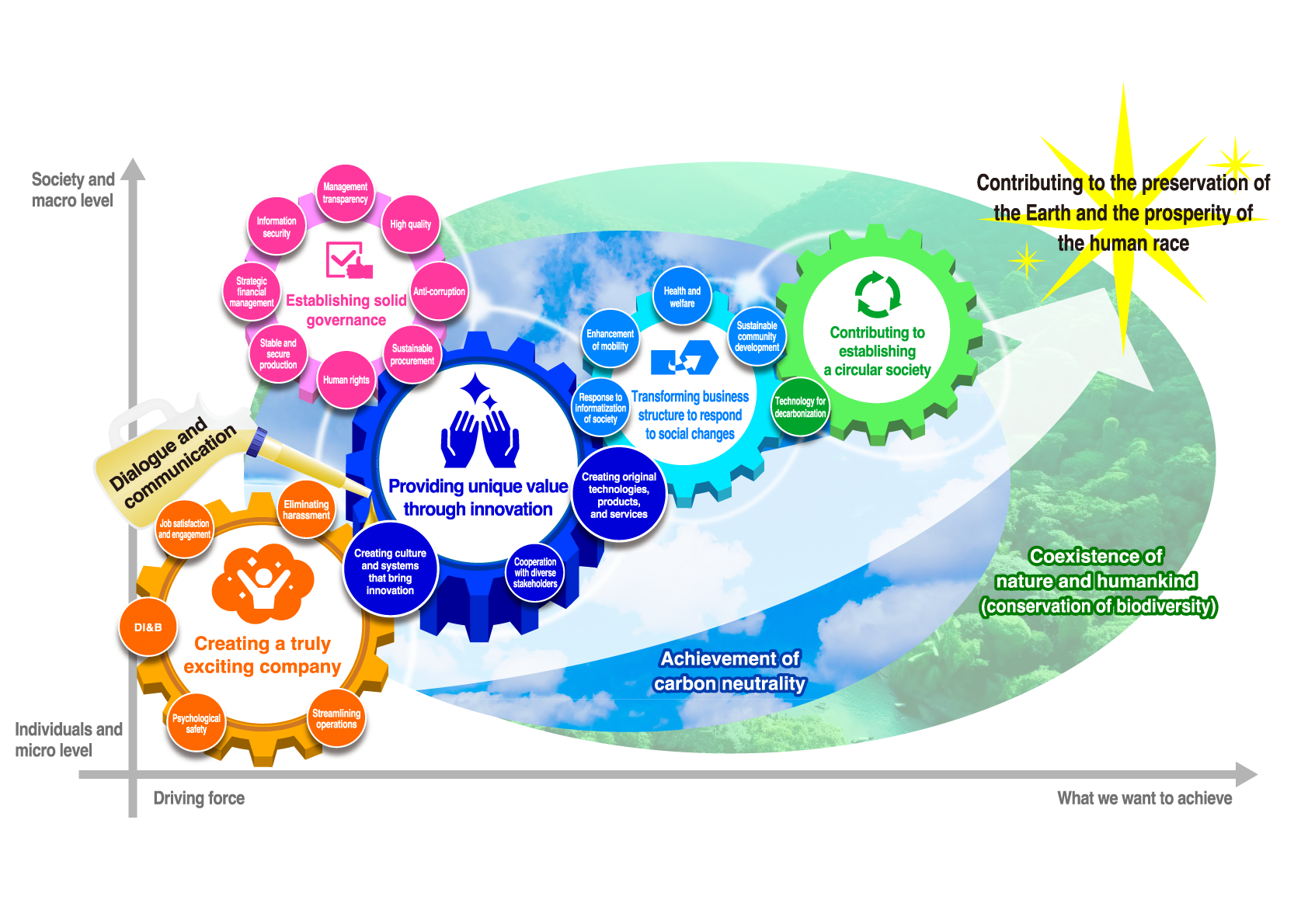
Examples of elements of each material issue
The diagram below shows examples of specific elements associated with each of the “Five Gears that drive Zeon.” Among these, we consider “creating systems and a culture that foster innovation” and “original technologies, products, and services”, which are elements of the “Providing unique value through innovation” gear, to be particularly important as key elements that keep all five gears moving. Therefore, they are depicted as larger circles in the diagram.
Positioning of the Five Gears that drive Zeon (materiality)
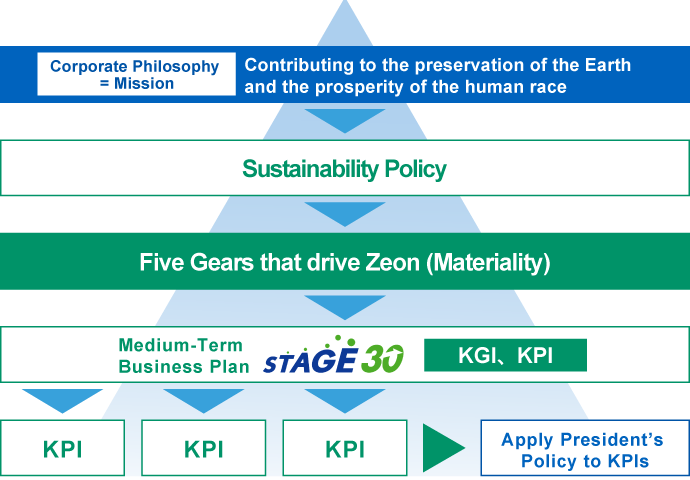
Under our Sustainability Policy, the “Five Gears that drive Zeon (materiality)” represent the key issues we must address to realize our corporate philosophy. In our Medium-Term Business Plan: STAGE30, we have set various KPIs and are carrying out initiatives based on the concept of the “Five Gears that drive Zeon.”
Materiality determination process
In April 2023, we launched the company-wide, cross-functional Materiality Determination Project consisting of members from various positions and age groups, which discussed material issues for about eight months, and in December 2023, the project determined the Zeon Group’s materiality with the approval of the Board of Directors. We conducted the materiality identification using the following steps.
1. Consideration of concepts and axes
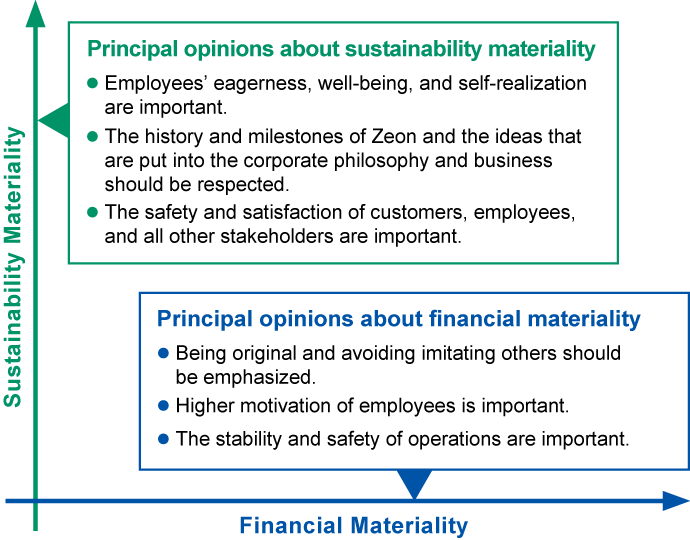
We started to determine our materiality based on the concept of double materiality with two axes: the impact on our finances (financial materiality) and the impact of our actions on society and the environment (sustainability materiality).
Based on general elements, we discussed elements that should be included in the two axes used above taking into account the principles and values Zeon considered important. Specifically, elements that should be emphasized in and added to financial materiality included Zeon’s originality, higher motivation of employees, and the safety and stability of operations, while those for sustainability materiality included employees’ eagerness, the history and milestones of Zeon, and the ideas that were put into the company’s corporate philosophy and business.
2. Extraction of candidates for materiality
Based on the social issues that each department identified as important when formulating Phase 2 of the Medium-Term Business Plan, we added the items presented during project discussions and those expected to gain increasing importance in future international discussions, and identified candidates for materiality as a basis for further discussion.
3. Evaluation and analysis of candidates for materiality
Based on the axes examined in Step 1, the project members discussed and evaluated the importance of the candidates for materiality extracted in Step 2. Then, to reflect social expectations and demands on materiality when determining it, we evaluated the importance of the candidates for materiality using factors such as the degree of attention paid by international NGOs, rating agencies, and other organizations and future market forecasts while also obtaining advice from external consultants. We reflected the results of these two-level evaluations, analyses of differences therein, etc. on discussions to determine materiality.
4. Interviews with top management
Furthermore, through interviews, we gained an understanding of management’s views on Zeon’s strengths and challenges, as well as their thoughts on the company’s future, and reflected these in our discussions.
5. Close examination and narrowing down of materiality and consideration of how to express it
We further discussed what the key elements of materiality are to create a narrative for the future of Zeon Group and society. We then formulated a materiality proposal, carefully crafting the wording, taking into consideration the relationships among the materiality topics and the timeline.
6. Approval by the Board of Directors
After deliberation by the Executive Committee (now the Management Committee), the proposed materiality was submitted to the Board of Directors and approved in December 2023.
Stakeholder Engagement
We believe that building relationships of trust with stakeholders is essential for us to continue to grow sustainably together with society to realize our corporate philosophy, “Contributing to the preservation of the Earth and the prosperity of the human race.”
We identify societal expectations indicated in our Vision for 2030 as the SDGs. With our stakeholders comprising business partners referring to our customers and suppliers, shareholders referring to our shareholders and investors, life — that is, people in society, starting with our local communities, and the lives they lead, and employees, we strive to continue our dialogue about a “Sustainable Earth” and the future and promote efforts to further deepen mutual understanding.
| Stakeholders | Stakeholder relations | Main communication channels |
|---|---|---|
| Customers | We are committed to providing safe, reliable, and high-quality products and services that live up to our customers’ trust. Through communication with our customers, we will develop products and services that help solve their challenges. Furthermore, we will collaborate with our customers to develop sustainable products that satisfy the diverse needs and expectations of the global market. |
|
| Suppliers | Our goal is to realize a sustainable society through our supply chain, by promoting responsible procurement activities in conformance with our Sustainable Procurement Policy. To that end, building strong partnerships with our suppliers is essential. We strive to gain supplier understanding of our approach to sustainable procurement, and work to achieve procurement sustainability. We also monitor the progress of each supplier’s activities and engage in dialogue toward improvement through procurement surveys and interviews. |
|
| Shareholders and investors | We will disclose information in a fair, impartial, and highly transparent manner, in a timely and appropriate way. We strive to bolster our corporate value through dialogue with shareholders and investors, to foster deeper understanding of our management policies and business activities. We also take external opinion seriously, and consider it in our management and information disclosure. |
|
| Local community | Each of our locations contributes to community development by ensuring reliable business operations as a member of the local community. We value communication with the local community and, by building trust, work together with the community, aiming to build a sustainable local community. |
|
| Employees | Our vision for 2030 is to be a company that lives up to societal expectations and the aspirations of employees. To make this vision a reality, we are evolving our personnel system and formulating personnel policies that help every employee bring their diverse abilities to bear and work with a sense of security and energy. We also welcome opportunities for dialogue, and strive sincerely to consider each employee’s opinions. |
|
Sustainability Management
Sustainability Promotion Structure
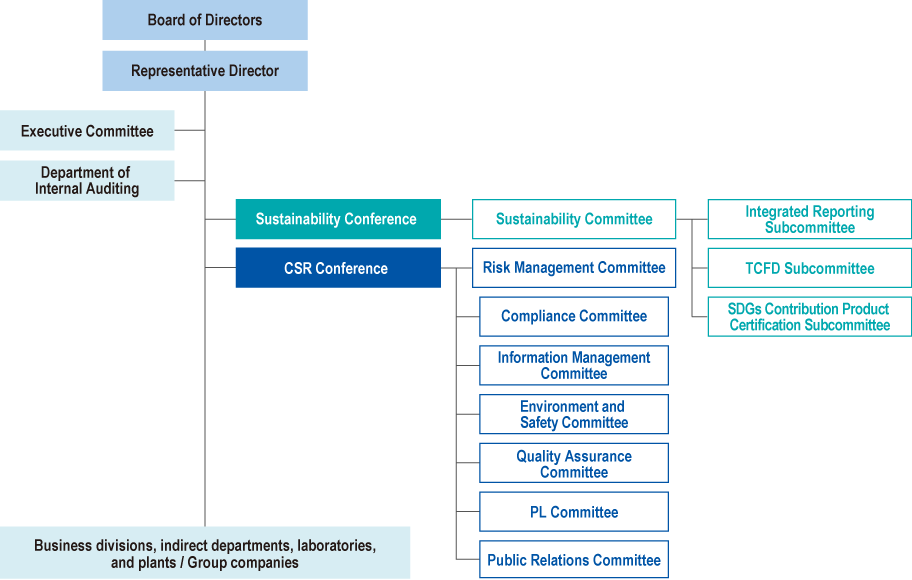
To promote sustainability initiatives across the whole company, we have established the “Sustainability Committee.” The Sustainability Committee examines policies and develops and promotes concrete measures to address material sustainability issues, including responses to climate change and human rights issues. In accordance with the characteristics of each issue, we establish theme-specific subcommittees to ensure highly specialized and effective deliberation and response to individual issues.
Matters examined and discussed by the Sustainability Committee are deliberated on and decided by the “Management Committee”, chaired by the Representative Director, and are reported to the Board of Directors as appropriate depending on the importance of the agenda items, thereby ensuring appropriate governance with the involvement of senior management.
In addition, from the perspective of supporting the Company’s sustainable growth, policies and measures related to risk management arising from business operations, environmental conservation, and occupational safety are also examined, planned, and promoted by the relevant committees.
Timeline of CSR/Sustainability Initiatives
| 1995 | Joined the Japan Responsible Care Council |
|---|---|
| 1997 | Established the Safety Philosophy |
| Held the first Zeon Safety Month and the All-Zeon Safety Conference (subsequently held each year in April) | |
| Established the Code of Conduct (Zeon’s Seven Articles) | |
| 1998 | Established the Responsible Care Policy |
| 1999 | Established the Crisis Management Rules |
| 2000 | Began publishing the Responsible Care Activity Report (from the FY1999 edition) |
| 2001 | Established the Environmental Philosophy |
| 2004 | Implemented the Internal Reporting System |
| Published the Compliance Textbook | |
| 2006 | Switched from publishing the Responsible Care Activity Report to publishing the CSR Report |
| 2009 | Signed the Responsible Care Global Charter |
| 2010 | Established the CSR Policy and CSR Code of Conduct |
| 2012 | Started the CSR Core Projects (comprehensive Zeon social contributions package) |
| 2013 | Switched from publishing the CSR Report to publishing the Corporate Report |
| 2017 | Revised the CSR Matrix based on ISO 26000 |
| Along with publishing the Corporate Report, also published a PDF version of the CSR Report on the corporate website | |
| 2019 | Became a signatory to the United Nations Global Compact |
| Established the Zeon Group Human Rights Policy | |
| 2020 | Endorsed the TCFD recommendations |
| 2021 | Established the Declaration for Health and Productivity Management |
| 2022 | Established the Sustainability Policy |
| Evolved from the Corporate Report into the Integrated Report; and refreshed the CSR Report as the Sustainability Report. | |
| Newly established the Sustainability Conference and Sustainability Committee | |
| 2023 | Determined the Five Gears that drive Zeon (materiality) |
| Established the Sustainable Procurement Policy | |
| Joined the GX League | |
| 2024 | Obtained validation of our targets by the Science Based Targets initiative (SBTi) |
| Began operating the SDGs Contribution Product Certification Program | |
| 2025 | Established the Cybersecurity Policy |
| 2026 | Endorsed the TNFD recommendations |