
Water Resource Conservation
Basic Approach
Zeon Group positions the conservation of water resources as a key issue for business continuity and works to make effective use of water and mitigate water risks through measures such as reducing water consumption through water-saving and wastewater reuse, and properly managing wastewater treatment and effluent quality.
At our production sites, after assessing local water stress conditions, we also take necessary measures to ensure that there are no adverse impacts on ecosystems or people’s livelihoods.
Structure and System
Zeon Group believes that climate change has a serious impact on our business, and in 2020 expressed its support for the recommendations of the Task Force on Climate-related Financial Disclosures (TCFD). Based on the TCFD recommendations, we analyze the risks and opportunities posed by climate change and reflect them in our business strategies to strengthen our business foundation, while also aiming to realize a sustainable society and improve Zeon’s corporate value.
With regard to water risks, we also recognize risks and opportunities such as floods and droughts caused by climate change, and we continue to promote measures from an environmental and safety perspective, such as preventing water pollution and reducing water withdrawal, that we have long been implementing.
Key Initiatives
Water management plan
As a company that uses large volumes of water, we strive to reduce water consumption at our production sites. We manage water intake using flow meters and have established a system to control both water volume and quality through water recycling within our facilities and wastewater treatment systems.
We also undertake initiatives to reduce water-related risks. Water risks are incorporated into the Group-wide risk management list, by which they are recognized as materialized risk. Each division also assesses risk impacts and considers appropriate measures.
In addressing flood risks, we have long conducted risk impact assessments from a business continuity planning (BCP) perspective and are advancing the consideration of necessary countermeasures. Regarding drought risks, we conduct simulations that assume water sharing from other sites and external procurement, including procedures and cost estimates, and have established a system that enables response as needed.
These risk assessments are reviewed annually, establishing a system that enables the implementation of necessary measures in response to changing environments.
Based on this water management plan, we take appropriate measures to manage water withdrawal and wastewater discharge so as to minimize environmental impact as much as possible, while taking into account improvements in water-use efficiency and ecosystem conservation.
Initiatives on water resources
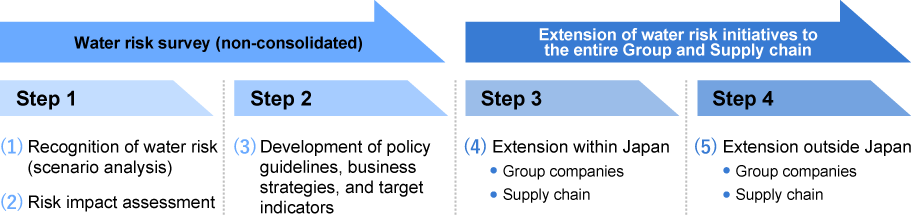
In our Group, water is indispensable for our manufacturing activities. If water resources were to become depleted or water quality deteriorated, we understand that it would be a serious risk to both our Group and local communities. It is with this recognition that we have been actively working on water risks since FY2022. Going forward, we will proceed with our initiatives in line with the steps outlined below.
- 1Identification of our risks and opportunities concerning water risk
- 2Establishment of Group-wide policies, targets, and indicators for water risk
- 3Promotion of PDCA for targets and indicators
- 4Disclosure of our initiatives to stakeholders
Water risk analysis
To appropriately identify and assess business risks related to water, the Zeon Group conducted a potential water risk analysis covering manufacturing sites of Zeon Corporation as well as its consolidated and non-consolidated subsidiaries in Japan and overseas. The analysis utilized the AQUEDUCT Water Risk Atlas developed by the World Resources Institute (WRI).
The results indicated that overall water risk across the Group tends to be low. However, four of the 31 sites analyzed (12.9%) are located in areas assessed as facing “extremely high” water stress. Among consolidated subsidiaries, one site was confirmed to be situated in a high water-stress area.
In addition to water stress, we also assessed water pollution risks associated with wastewater discharge. The assessment confirmed that several of our sites are located in areas that could be considered relatively high risk in terms of water quality impacts. These findings provide important insights for identifying priority areas in the Group’s water resource management efforts.
Going forward, the Zeon Group will continue working to enhance the accuracy of its water risk analysis while advancing the consideration and strengthening of necessary measures based on the risk level of each site. Through these efforts, we remain committed to the sustainable use of water resources and environmental conservation.