
Resource Circulation and Pollution Prevention
Basic Approach
Environmental philosophy
Established in 2001, our Environmental Philosophy guides our efforts to deliver products with consistent quality through safe and reliable production while reducing our environmental impacts.
- 1Environmental protection is a mission of a socially responsible organization
- 2Our basic belief is that environmental protection can be achieved with innovative technology
- 3Environmental protection will be achieved when all employees work together with a sense of mission to overcome challenges
Responsible Care Policy
- 1Prioritize the environment and safety
Protecting the environment and ensuring safety are preconditions for all business activities and are the most important priorities. We will work continuously to enact full accident prevention countermeasures, and provide education and training for all employees to prevent safety and environmental accidents.
- 2Collect and distribute the latest information on chemical products
We will collect, store and manage the latest information required for the appropriate handling, use and disposal of chemical products, and distribute this information to employees and users.
- 3Minimize the discharge of toxic chemicals and waste
We will work to reduce the discharge of hazardous chemical substances, minimize waste, and develop technology for recycling and reusing materials.
- 4Promote activities for conserving resources and energy
We will aim to dramatically reduce the amount of energy we use and help alleviate global warming by developing innovative technology and actively promoting resource and energy conservation activities that involve all employees.
- 5Take the environment and safety into account when developing new processes and products and performing quality assurance
We will perform thorough environmental and safety evaluations from the initial stages of research, develop technology and products that take the environment and safety into account, and work to maintain and improve the quality of technology and products.
- 6Live together with society
We will strictly observe regulations related to the environment and safety, whether the regulations come from the local community, the national government, overseas, or organizations to which we belong. While cooperating in these activities, we will work to enhance our communication with the local community and society in order to convey a better understanding of Zeon’s activities and further strengthen the trust that society has in our company.
- 7Perform continuous improvements
We will continuously improve our environment safety management and technology by operating a Responsible Care Audit, the Safety Management System, an Environment Management System based on ISO 14001, and an Occupational Health and Safety Management System.
Structure and System
We have built environmental and safety management systems based on the Responsible Care philosophy, and are working toward the goal of ensuring the safety of all persons at our worksites and plants. We have also obtained ISO 14001 external certification related to the environment.
Overview of environmental and safety management systems
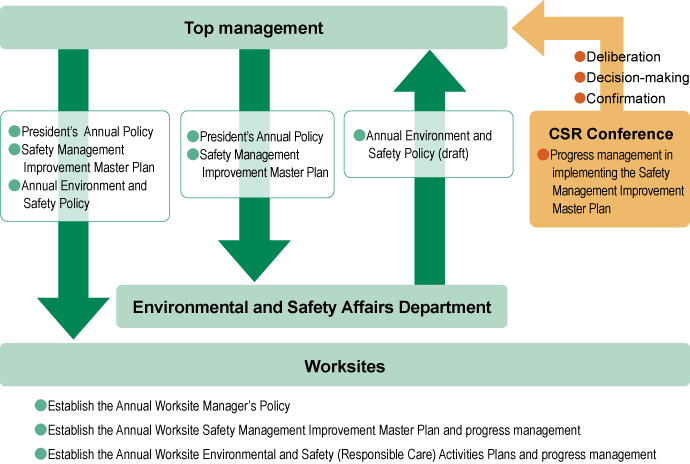
The management systems are operated through hierarchical policies and plans as outlined below.
- President’s Annual Policy and Safety Management Improvement Master Plan
- These documents are created by top management.
- Annual Environment and Safety Policy
- The General Manager of the Environmental and Safety Affairs Department creates this policy after the President’s Annual Policy and the Safety Management Improvement Master Plan are released. The Annual Environment and Safety Policy is reviewed by the CSR Conference and finalized by the President.
- Annual Worksite Manager’s Policy and Annual Worksite Safety Management Improvement Master Plan
- Worksite managers create these documents after the President’s Annual Policy and the Safety Management Improvement Master Plan are released.
- Annual Worksite Environmental and Safety (Responsible Care) Activities Plans
- Worksite managers create the Activities Plans after the Group-wide Annual Environment and Safety Policy is released.
Progress management
The CSR Conference, chaired by the Representative Director, together with the Environment and Safety Committee under its supervision, deliberates on company-wide planning and progress management related to environmental management and occupational health and safety. The executive officer in charge of environmental safety serves as chair of the Committee.
- Safety Management Improvement Master Plan: Progress verified by the CSR Conference
- Annual Worksite Safety Management Improvement Master Plan: Progress verified by the worksite manager during worksite inspections
- Annual Worksite Environmental and Safety Activities Plans: Progress verified by the worksite manager during worksite inspections
Key Initiatives
Chemical substances management
PRTR* initiatives
Based on the Act on Confirmation, etc. of Release Amounts of Specific Chemical Substances in the Environment and Promotion of Improvements to the Management Thereof (PRTR Act), we report annually to the government the amounts of designated chemical substances manufactured or used by the Company, including their releases into the environment and transfers.
We will continue strengthening the management of PRTR-applicable substance emissions and aim to maintain emissions at or below the FY2010 level, in line with the voluntary targets established by the Japan Chemical Industry Association. Specifically, we aim to maintain total annual emissions from our domestic sites at 36.7 tons or less and are promoting equipment modifications and other measures toward further reductions.
- *PRTR: Pollutant Release and Transfer Register
Air and water
Atmospheric emission reductions of hazardous chemical substances
We are installing collection facilities, implementing measures including improving facilities to prevent evaporation from openings in manufacturing facilities, and systematically reducing emissions of butadiene and acrylonitrile, which are among the substances requiring priority action under the Japan’s Air Pollution Control Act.
Initiatives to prevent air pollution
Our emissions of NOx and SOx, which are air pollutants, occur during the combustion of fuels such as BC heavy oil.
Each worksite complies with regulatory limits under pollution-related laws and regulations and with voluntary management standards, striving to curb emissions in daily operations.
We are also promoting measures such as the adoption of heavy oil with low sulfur (S) content and conversion to liquid natural gas (LNG).
Going forward, we will proceed with technical and economic assessments toward converting to fuels with lower environmental impact, aiming for even lower emission levels.
In addition, we continuously monitor and work to reduce emissions of hazardous air pollutants designated under the Air Pollution Control Act as priority substances due to their potential health risks. For example, at our domestic sites, we are strengthening acrylonitrile recovery facilities and implementing equipment improvements to prevent evaporation from manufacturing equipment openings, while studying technologies to achieve a target acrylonitrile emission level of 1 ton or less per year.
Initiatives to prevent water pollution
We set regulatory limits stipulated by laws and local ordinances related to water pollution as our target values, and monitor emissions of COD*, nitrogen, phosphorus, and other substances to help preserve the aquatic environment. Each of these emissions is controlled at levels below the established targets.
At our domestic production sites, where water usage is high, wastewater from each plant is collected and treated through processes such as neutralization, oil separation, and removal of solid matter. In addition, we employ activated sludge treatment using microorganisms to decompose organic substances in wastewater.
- *COD: Chemical Oxygen Demand
Waste reductions
As part of our efforts to reduce the amount of industrial waste destined for final landfill disposal, our worksites achieved the standard of less than 0.1% of the industrial waste generated in FY2007, realizing zero emissions in FY2011. Since then, we have maintained that status.
Zeon Group companies also had a final landfill volume of more than 600 tons in FY2007, but since FY2012 this has been reduced to around 10 tons, or roughly 0.4% of the industrial waste generated in FY2007. This is considered zero emissions.
The Group companies will aim to maintain a final landfill volume of 5 tons or less per year, the same as at our worksites.
Initiatives to reduce industrial waste from plastic products
Article three in our Responsible Care Policy is “Minimize the discharge of toxic chemicals and waste.”
Under the Act on Promotion of Resource Circulation for Plastics, which came into force in April 2022, Zeon is classified as a business that generates a large amount of industrial waste from plastic products (250 tons or more per year). In line with the spirit of the Act, we are working to reduce the amount of waste we generate, while also formulating medium- to long-term targets and plans to manage waste.
Chemical product safety information
We collect and provide safety information on our chemical products. We also conduct hazard assessments.
For quality assurance, see Quality Management.
Information for the proper handling of chemical products
We produce Safety Data Sheets (SDS) providing information including GHS*1 classification results, product hazards, and cautions for handling, etc.
For some of our products, we also compile safety-related information in the form of safety abstracts, which are made available on the GPS/JIPS*2 platform.
- *1GHS
Globally Harmonized System of Classification and Labelling of Chemicals - *2GPS/JIPS
Global Product Strategy / Japan Initiative of Product Stewardship. An industry voluntary initiative promoted by the Japan Chemical Industry Association, based on the fundamental concept of the global initiative by the International Council of Chemical Associations (ICCA)
Participation in voluntary chemical industry initiatives
Zeon provides financial support for research activities by the LRI*1 to assist in efforts such as chemical substance hazard reviews, safety evaluations, and environmental impact surveys. Zeon also participates in the Technology Subcommittee and the Environment Subcommittee of the Asia Pacific Section of the IISRP*2. In international meetings, Zeon proactively participates in activities to improve the overall level of technology in the global rubber industry and to promote sustainability
- *1LRI
Long-range Research Initiative: Activities to provide long-term support for research on the impact of chemical substances on health and the environment. A program under the auspices of the International Council of Chemical Associations (ICCA) that is carried out with funding from LRI member companies and in cooperation with the chemical industries of Japan, the United States and Europe (specifically, the Japan Chemical Industry Association, American Chemistry Council and European Chemical Industry Council). - *2IISRP
International Institute of Synthetic Rubber Producers